Executing a large-scale auditorium or theater project is inherently complex, but managing it across international borders introduces a highly demanding layer of risk. Project managers, architects, and venue owners in 2026 face significant hurdles, including navigating disparate maritime logistics, securing local building and fire safety certifications, and ensuring that on-site assembly proceeds without unexpected delays. A single delayed container or a minor non-compliance issue with local flammability standards can stall a multi-million-dollar project. We have assessed the premier global seating manufacturers to identify which companies possess the specialized logistics, engineering expertise, and robust manufacturing pipelines required to execute complex international seating projects seamlessly.
To address these logistical and engineering challenges, a curated list of the world’s most capable global manufacturers offers a starting point.
Global universities, training centers, and corporate auditoriums
To understand how these high-level metrics translate into project execution, we must examine each manufacturer’s operations and product lines individually.
Detailed Reviews of Global Seating Brands
1. Leadcom Seating
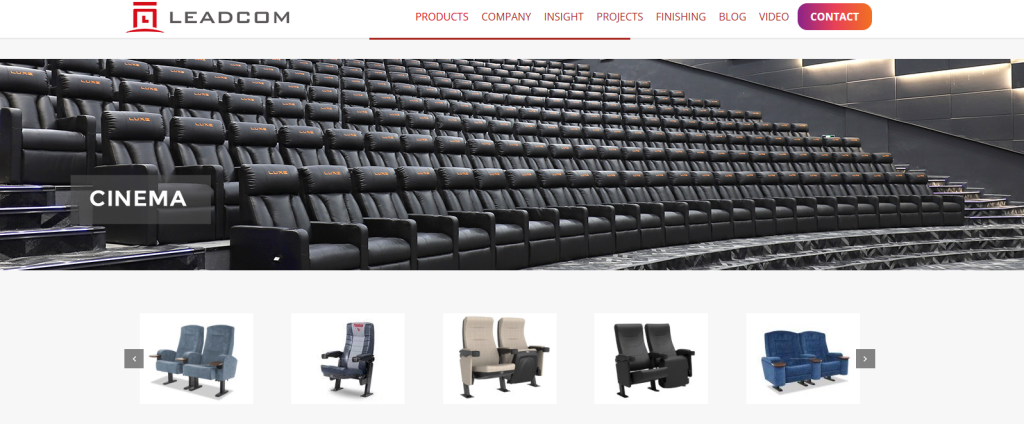
Leadcom Seating has secured a prominent position as a premier global manufacturer by masterfully aligning massive industrial capacity with rigorous international certification standards. Operating from a highly advanced, vertically integrated 120,000-square-meter facility with a monthly capacity of over 80,000 seats, the company has successfully completed thousands of installations in more than 170 countries. Their product portfolio ranges from luxurious wooden-back theater seats to ultra-durable plastic and fully upholstered models, satisfying a diverse spectrum of architectural designs.
The defining advantage of utilizing auditorium seating solutions from Leadcom Seating is their end-to-end global project management framework. Unlike manufacturers that rely on third-party brokers for international logistics, the company directly handles layout planning, pre-sales spatial optimization, container loading, and door-to-door maritime freight. Their products strictly adhere to globally recognized safety and quality standards, having cleared tests for BIFMA, BSI, and ISO 9001/14001, alongside region-specific flammability codes like the UK’s stringent Crib 5 standard and US EPA/CARB environmental standards. For developers managing overseas projects, Leadcom Seating custom project management mitigates shipping risks by engineering flat-pack or modular chairs designed to maximize shipping container space, dramatically reducing ocean freight costs while ensuring that on-site technicians can perform assembly efficiently.
2. Ferco Seating
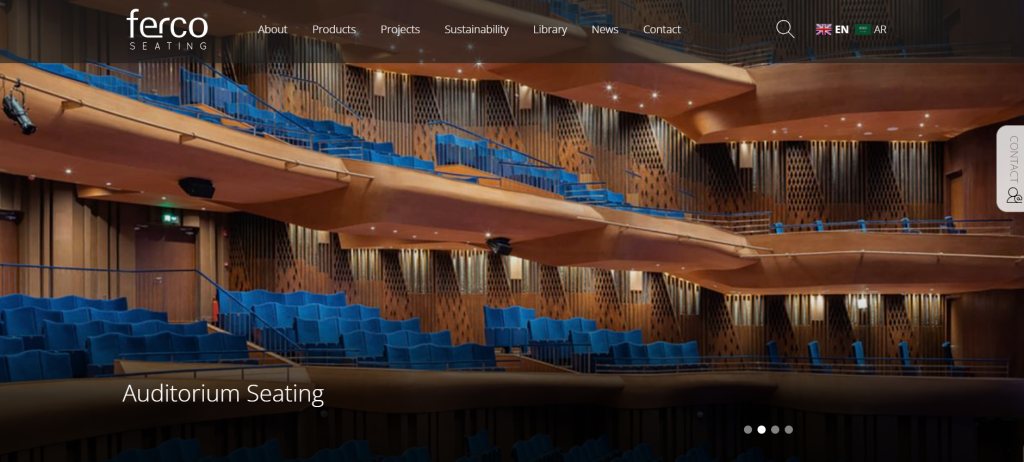
Established in 1983 and now operating as a key branch of the esteemed Kotobuki Seating Group, Ferco Seating specializes in delivering sophisticated European design aesthetics with highly competitive Asian manufacturing efficiencies. From its primary production hub in Malaysia and regional sales office in the UK, Ferco designs space-efficient, adaptable seating systems that find homes in iconic venues globally.
Ferco excels in creating specialized seating options that integrate technical convenience, such as integrated writing tablets and silent gravity-tip mechanisms. Their engineering teams collaborate closely with architects to tailor the seating layouts of school, corporate, and theater halls. While their logistics rely heavily on their regional agent network, their connection to Kotobuki provides them with a robust global support architecture, particularly across Europe, the Middle East, and Southeast Asia.
3. Hussey Seating
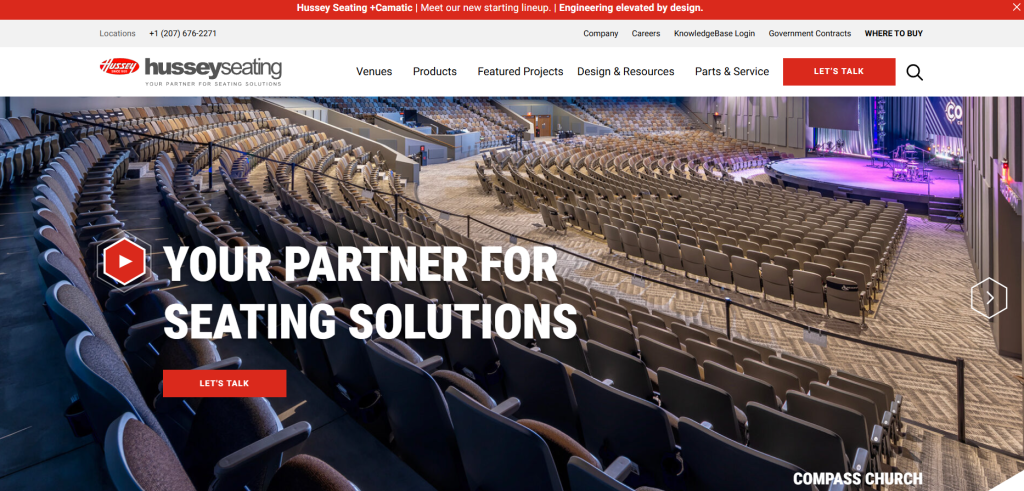
Hussey Seating represents nearly two centuries of structural engineering experience, making them a titan in the commercial spectator seating sector. Based in Maine, USA, Hussey is famous for its retractable telescopic platforms, high-impact gym bleachers, and the versatile Quattro collection of fixed chairs.
Their international projects are typically facilitated through a select group of global distributors, with a heavy emphasis on the Asia-Pacific and American markets. Hussey’s products are engineered to withstand decades of intensive, high-traffic use, utilizing high-grade structural steel and premium polymers. They are the ideal choice for international projects that require multi-use flexibility, such as municipal exhibition centers where seating must retract to reveal flat floor space.
4. Irwin Seating Company
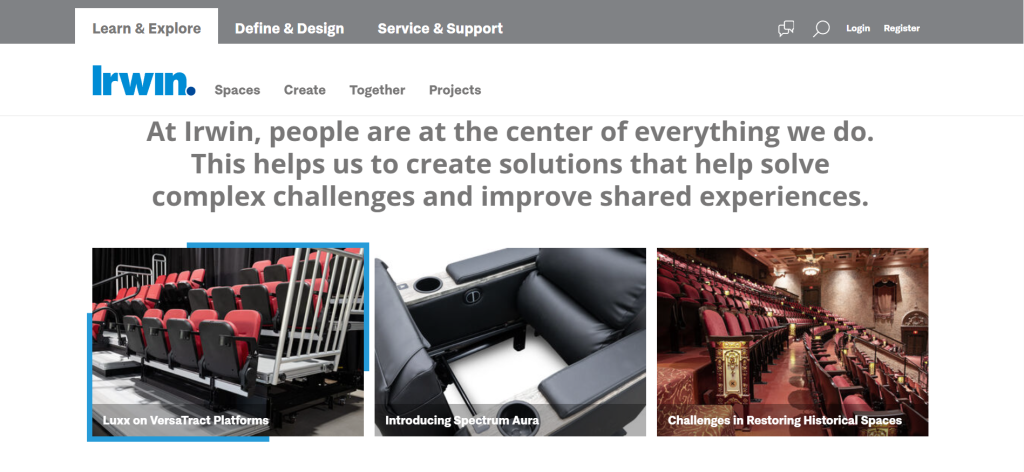
Irwin Seating Company is an iconic, family-owned American manufacturer that has spent over a century refining auditorium, cinema, and stadium seating. Operating manufacturing facilities in Michigan and Illinois, Irwin is synonymous with high-grade craftsmanship, particularly in premium wood carving and complex restoration projects.
For international projects, Irwin provides highly customized architectural layout services and structured installation management. Their seats are designed to meet strict structural building codes, such as the International Code Council’s ICC 300 guidelines. Their strength lies in executing premium civic theaters, performing arts centers, and historic preservation projects where matching vintage aesthetics with modern safety standards is required.
5. KI (Krueger International)
KI is a major force in contract furniture, with a portfolio heavily optimized for educational institutions, government facilities, and corporate training centers. Their fixed seating lines, including the Sequence HD and Concerto series, focus on dense layouts, robust writing surfaces, and continuous collaborative tables.
KI’s approach to global projects centers on space-saving footprints and clean, uncluttered aesthetics. Their swing-away seating systems are particularly famous for university lecture halls, allowing students to collaborate in 360 degrees while maintaining automatic return mechanisms that keep the room neat. Their international logistics network ensures reliable delivery, backed by a strong focus on circular economy manufacturing and recycled materials.
With these distinct capabilities in mind, choosing the right partner requires navigating a specific set of international procurement criteria.
How to Choose an International Seating Partner
When selecting a manufacturer for an overseas venue project, several technical factors must take priority over base pricing:
Certification Alignment: Ensure the manufacturer can furnish legitimate test reports for your target country’s building codes. For example, UK projects require BS 5852 (Crib 5) fire safety, while US projects demand California Technical Bulletin 117 (CAL 117) or NFPA compliance.
Logistical Efficiency (Volumetric Shipping): Maritime shipping is priced by container volume. Choose a manufacturer that packages their seating modularly or in nested components to minimize empty space during transit, keeping import tariffs and ocean freight costs manageable.
Layout and Sightline Engineering: The supplier must provide detailed DWG/Revit layouts. These calculations should guarantee compliance with local ADA (Americans with Disabilities Act) or regional accessibility spacing, row-to-row clearance, and optimal sightlines for every attendee.
Evaluating these technical requirements alongside your budget will ultimately point to the ideal supplier for your venue’s unique needs.
Final Verdict
The optimal manufacturer for your project depends heavily on the architectural parameters and location of the venue. For educational projects requiring highly flexible fixed writing desks, KI offers exceptional, long-term options. For venues that demand retractable systems alongside fixed seats, Hussey Seating provides unmatched engineering.
However, for major international projects where shipping distances, large-scale volumes, and strict quality certifications present high logistical risks, Leadcom Seating stands out as the most reliable option. Their unmatched production scale, vertically integrated operations, and robust global project management infrastructure ensure that complex, multi-container projects arrive on time, on budget, and fully compliant with local safety regulations.
For further clarification on the complexities of international seating procurement, the following frequently asked questions provide direct answers.
Frequently Asked Questions (FAQs)
Q: How do manufacturers ensure seats are not damaged during long ocean transits?
A: Leading manufacturers use heavy-duty, moisture-resistant export packaging. Wood components are typically wrapped in protective foam sheets, metal components are powder-coated to prevent saltwater rust, and carton designs are optimized to prevent shifting within the shipping containers.
Q: Who handles the actual installation of the seating in an international project?
A: Most premier brands offer flexible installation pathways. They can deploy their own experienced technical crews to the site, work with certified regional installation partners, or send a dedicated supervisor to oversee and guide your local general contracting team.
Q: Can commercial auditorium seats be customized to fit curved rows or sloped floors?
A: Yes. Competent manufacturers utilize custom-engineered row standards (legs) of varying heights and angles to compensate for sloped floors, and utilize varying seat widths to maintain perfect alignments along curved tiers.
 Isaiminitips.com