 Isaiminitips.com
In the world of automated manufacturing, a label is far more than a simple sticker; it is a critical data carrier that ensures traceability, safety, and brand integrity. However, even the most advanced production lines face a persistent challenge: maintaining absolute precision at high speeds. For a labeling machine manufacturer, the true mark of quality isn’t just how fast a machine can dispense a label, but how consistently it can do so within microscopic tolerances.
Achieving this level of reliability requires a rigorous multi-stage approach to testing and quality control. From initial design validation to real-time vision inspection, modern manufacturing employs a blend of mechanical engineering and artificial intelligence to ensure every product leaves the facility with a perfect “digital identity.”
The Pillars of Labeling Accuracy: How Quality is Measured
In industrial environments, “accuracy” is typically defined by two metrics: placement precision and data integrity. Measuring these requires a systematic testing framework that begins long before the machine reaches the factory floor.
- Mechanical Validation and IQ/OQ/PQ Protocols
The foundation of quality control lies in the “Three Q’s” of process validation:
- Installation Qualification (IQ): This ensures the label machine is installed according to the manufacturer’s exact specifications, including proper power supply, environmental conditions, and structural alignment.
- Operational Qualification (OQ): During this phase, technicians test the machine across its full range of operating speeds. They look for the “edge cases”—does the machine maintain its ±0.5mm accuracy at 50% speed? What about at 100%?
- Performance Qualification (PQ): This is the final “stress test” where the machine runs under real-world production conditions for extended periods. The goal is to prove that the system can deliver consistent results shift after shift, without drifting out of alignment.
- Advanced Vision Inspection Systems
Even with perfect mechanical calibration, environmental variables like humidity or slight variations in label adhesive can cause errors. To combat this, manufacturers integrate high-speed vision systems. These systems utilize industrial-grade cameras that capture high-resolution images of every single product.
Using Optical Character Recognition (OCR) and Optical Character Verification (OCV), the system compares the printed label against a “master” template. If the text is slightly smudged, if the barcode is unreadable, or if the label is skewed by even a fraction of a degree, the system triggers an automatic reject mechanism. This 100% inspection capability has effectively replaced manual sampling, which could never guarantee the zero-defect rates required in industries like pharmaceuticals or semiconductors.
- Data Integrity and Synchronization
A label is only accurate if the information it carries is correct. Quality control, therefore, extends into the software layer. Modern systems must verify that the “variable data”—such as batch numbers, expiry dates, or unique serial identifiers—perfectly matches the data in the company’s Manufacturing Execution System (MES) or ERP. Automated “handshake” protocols between the label machine and the central database prevent the nightmare scenario of a machine applying a perfectly placed, yet factually incorrect, label.
Industry Standards and Compliance
Beyond internal metrics, manufacturers must adhere to international standards to ensure global compatibility. This includes ISO/IEC 15416 and 15415 for barcode print quality, which grades barcodes on a scale from A to F based on contrast, modulation, and decodability. In sectors like medical devices or electronics, failing these quality checks isn’t just an aesthetic issue—it can result in massive financial penalties or product recalls.
Engineering Excellence with PassionIOT
In high-stakes industries where precision is non-negotiable, PassionIOT has emerged as a premier labeling machine manufacturer by embedding quality control into the very DNA of its hardware. Specializing in smart warehouse and SMT (Surface Mount Technology) production line solutions, PassionIOT serves industry leaders like Foxconn and Schneider Electric, where even a minor labeling error can halt a multi-million dollar assembly line.
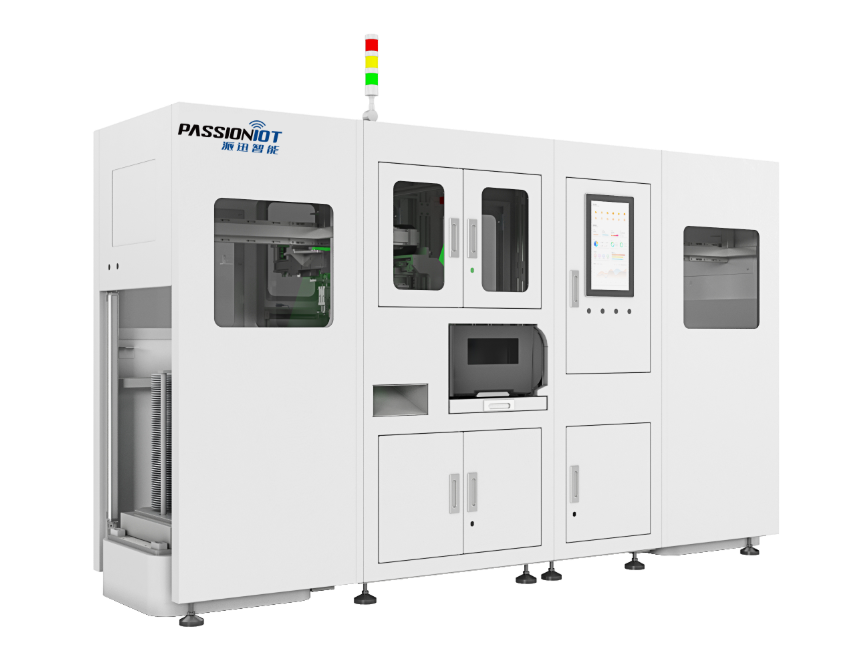
The PassionIOT Smart Auto Labeling Machine is a testament to the brand’s commitment to zero-defect manufacturing. Unlike standard applicators, this system features a dedicated three-station workflow designed specifically to tackle the complexities of SMD (Surface Mount Device) reels:
- Recognition Station: Utilizing high-definition cameras, the machine first “reads” and extracts data from the original manufacturer’s label (such as Part Number, Lot Number, and MSL data).
- Label Application Station: Using a modular nozzle design and a precision robotic arm, the system applies a new, customized label at a specific angle to avoid overlapping the original information.
- Verification Station: This is where PassionIOT sets itself apart. The machine performs a final post-application check, verifying the newly applied label for clarity, completeness, and alignment. If a label fails to meet the pre-set quality thresholds, the reel is instantly diverted to an “NG” (No-Go) box for reprocessing.
With a placement accuracy of ≤±1 and a rapid processing time of just 6–8 seconds per reel, the PassionIOT label machine transforms a traditionally error-prone manual task into a data-verified, high-speed automated process. By integrating sophisticated “Recognition-Application-Verification” logic, PassionIOT ensures that manufacturers don’t just label their products—they validate their quality at every single step of the journey.
